



Decisions, action items, and key points
Pull what was decided and who agreed to do what out of a recording, and turn it into a reminder.
What Orsola can pull out
Open a finished meeting. Its card has two sections for this:
- Action Items — who agreed to do what. Orsola lists these by itself once the meeting has been processed.
- Insights — four cards: Summary, a short overview of the whole meeting; Key Points, what actually mattered; Decisions, what was settled as opposed to discussed; and Topics. Choosing one asks Orsola to write it for this meeting, and the answer arrives in the conversation.
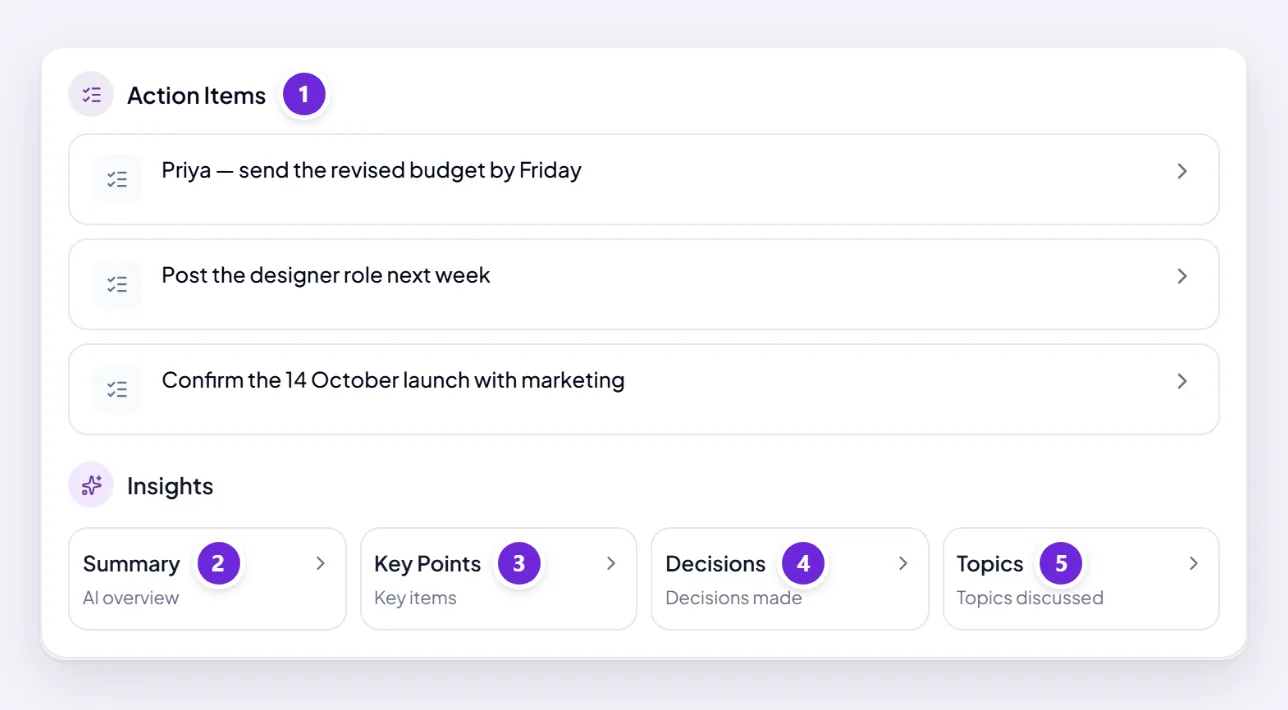
Because Insights are produced on request, a meeting you never asked about has none — nothing is missing, it just has not been asked for.
Ask for what you actually need
A specific question, typed in the message box below the meeting, is usually the better tool, and cheaper than generating everything and reading it:
- "What did we agree about the launch date?"
- "Did anyone object to the budget, and what was the objection?"
- "What did I commit to doing?"
- "Was the Vance contract mentioned at all?"
That last shape is worth knowing: asking whether something came up at all is a fast way to check a meeting you were only half in.
Each generation costs credits, since it is real work across the transcript.
Turn an action item into a reminder
Nothing here schedules itself. To make an action actually happen, ask for it in the ordinary way:
"Remind me on Thursday to send the revised quote we agreed in that meeting."
Ask for something to happen later or every week covers the scheduling side. Action items are a record of what was said, not a to-do list that acts on its own.
When to double-check it
Insights inherit the transcript's accuracy. Two cases deserve a second look:
- Attribution. If speaker labels were off — everyone on one label, or people talking over each other — "who agreed to do what" is the first thing to get scrambled.
- Decisions that were nearly made. A discussion that circled and settled on nothing can read as a decision in a summary. If it matters, check the transcript around it.
Before acting on something with money or a deadline attached, search the transcript for the moment — read the transcript and get the summary.
Where to go next
Checking an answer before you rely on it covers the wider habit.